
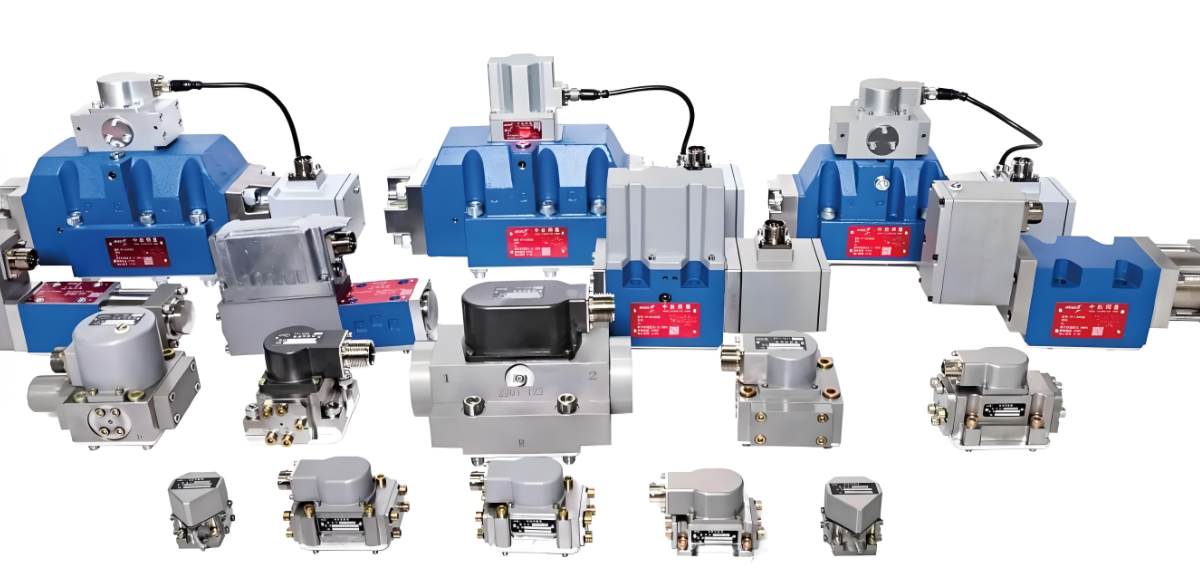
The thrust control servo valve is a crucial component in the aviation engine system, responsible for precisely controlling the engine's thrust according to the pilot's commands or the automatic adjustment requirements of the flight control system. By adjusting the fuel injection volume and timing, the thrust control servo valve achieves precise control of the engine's thrust, thus ensuring the stability and maneuverability of the aircraft under different flight conditions.
Working Principle of Thrust Control Servo Valve
The thrust control servo valve is a hydraulic servo valve, whose working principle is based on hydraulic principles. When the pilot issues a command through the thrust control handle in the cockpit, the hydraulic system in the cockpit converts the command into a hydraulic signal. This signal travels through the control oil circuit of the servo valve, driving the movement of the piston inside the servo valve, thereby controlling the opening of the engine nozzle, adjusting the fuel injection volume and timing, and thus changing the engine's thrust output.
Importance of Thrust Control Servo Valve
The thrust control servo valve plays a crucial role in the aviation engine system. Firstly, it ensures that the engine can perform precise thrust control according to flight requirements under different flight conditions, thus ensuring the flight safety and maneuverability of the aircraft. Secondly, the performance of the thrust control servo valve directly affects the fuel efficiency of the aircraft, and its precise control of fuel injection volume and timing can effectively reduce fuel consumption and lower flight costs. Finally, the performance of the thrust control servo valve directly affects the flight performance of the aircraft, such as acceleration performance, climbing performance, and flight stability, etc.
Trend of the Development of Thrust Control Servo Valve
With the continuous development of aviation technology, the requirements for thrust control servo valves are also increasing. On the one hand, in order to meet more stringent emission standards, thrust control servo valves need to control the fuel injection volume and timing more accurately to reduce emissions. On the other hand, to improve the engine's thrust output, thrust control servo valves need to control fuel injection more efficiently to improve engine efficiency. In addition, with the application of intelligent flight control systems, thrust control servo valves also need to have a higher level of intelligence, capable of achieving more precise thrust control and more efficient fuel management.
In summary, the thrust control servo valve is an indispensable and crucial component in the aviation engine system, whose performance directly affects the flight safety, fuel efficiency, and flight performance of the aircraft. With the continuous development of aviation technology, the requirements for thrust control servo valves are also increasing, and the future development trend of thrust control servo valves will be more intelligent, efficient, and environmentally friendly.