
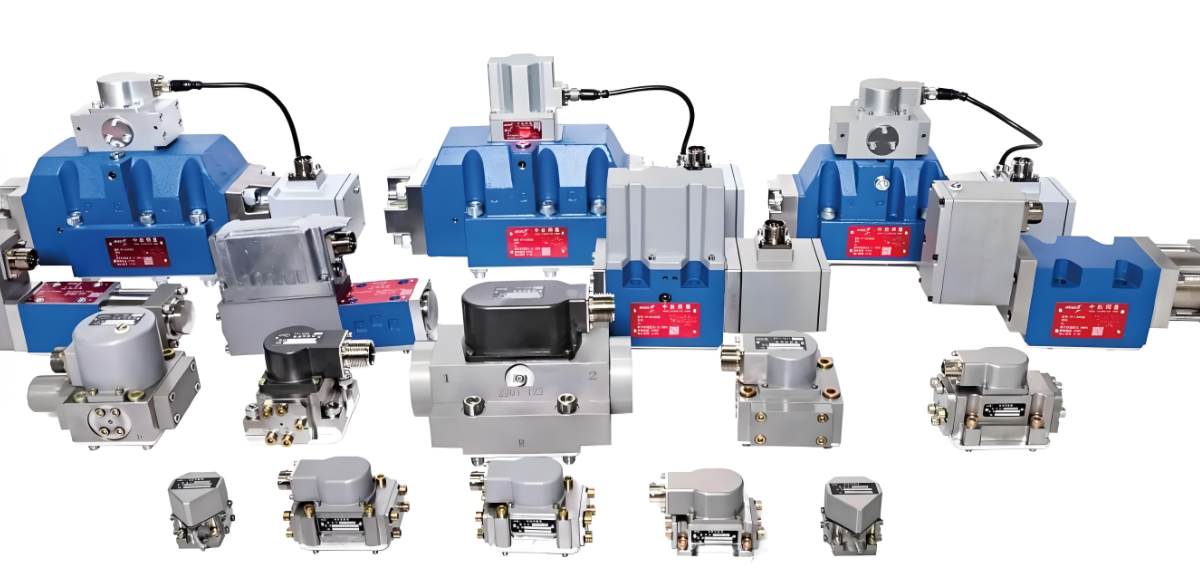
In the landscape of modern industrial automation and precision control, the closed-loop electro-hydraulic system with servo valve stands as a core technology that integrates electrical control precision with hydraulic power density. Unlike open-loop systems that lack feedback mechanisms, this closed-loop configuration leverages the servo valve as a critical interface to achieve real-time correction of output deviations, ensuring unparalleled accuracy and stability. Widely adopted in aerospace, manufacturing, energy, and other high-demand sectors, it has become an indispensable cornerstone of advanced engineering systems. This article explores the structural composition, working mechanisms, core advantages, typical applications, and future trends of closed-loop electro-hydraulic systems with servo valves, unraveling their significance in modern industrial control.
1. Structural Composition of Closed-Loop Electro-Hydraulic System with Servo Valve
A closed-loop electro-hydraulic system with servo valve is a highly integrated system consisting of five core components, each performing a unique function to ensure the overall operation of the closed-loop control. These components work in synergy to convert electrical signals into precise hydraulic power outputs while continuously correcting deviations.
The first core component is the electrical control unit, which serves as the "brain" of the system. Typically composed of programmable logic controllers (PLCs), microcontrollers, or dedicated motion controllers, it generates and processes control signals based on preset parameters or external input commands. For example, in a CNC machine tool application, the control unit calculates the required displacement or speed of the executive component based on the machining program and outputs a corresponding electrical signal (usually 0-10V voltage or 4-20mA current).
The second key component is the servo valve, the critical "bridge" between electrical signals and hydraulic power. As a high-precision control valve, it can proportionally adjust the flow and direction of hydraulic oil according to the input electrical signal. The most common types used in such systems include electro-hydraulic servo valves and proportional servo valves, with the former offering higher response speed and precision. The servo valve's performance—such as response time, linearity, and repeatability—directly determines the overall control accuracy of the system.
The third component is the hydraulic power unit, which provides the necessary energy for the system. It includes a hydraulic pump, oil tank, pressure relief valve, and filters. The hydraulic pump converts mechanical energy (from an electric motor) into hydraulic energy, supplying high-pressure hydraulic oil to the servo valve. The pressure relief valve ensures that the system pressure remains within a safe range, while the filter maintains the cleanliness of the hydraulic oil to prevent servo valve clogging and wear.
The fourth component is the hydraulic actuator, which executes the control command to drive the load. Common actuators include hydraulic cylinders (for linear motion) and hydraulic motors (for rotational motion). The actuator converts the hydraulic energy from the servo valve into mechanical energy, driving the load to achieve the desired motion (e.g., linear displacement of a machine tool slide or rotational speed of a robotic arm).
The fifth and most distinctive component of the closed-loop system is the feedback sensor, which enables the system to "self-monitor" and correct deviations. Common feedback sensors include linear variable differential transformers (LVDTs) for measuring linear displacement, rotary encoders for measuring rotational angle or speed, and pressure sensors for measuring system pressure. The sensor continuously transmits the actual operating parameters of the actuator to the electrical control unit, forming a closed-loop control chain.
2. Working Mechanism of the Closed-Loop Control Cycle
The operation of a closed-loop electro-hydraulic system with servo valve follows a continuous and dynamic closed-loop control cycle, which can be divided into five sequential stages. This cycle ensures that the system's output always matches the desired command, even in the presence of external disturbances.
Stage 1: Command Input and Signal Generation. The electrical control unit receives a desired motion command (e.g., "move the hydraulic cylinder 50mm to the right" or "maintain the motor speed at 1500 rpm") from an operator, a machining program, or an upper-level control system. It then converts this command into a standard electrical control signal (e.g., a 5V voltage signal corresponding to 50mm displacement).
Stage 2: Electro-Hydraulic Conversion by the Servo Valve. The electrical control signal is transmitted to the servo valve's torque motor or solenoid. For an electro-hydraulic servo valve, the torque motor generates a magnetic force proportional to the input current, driving the valve spool to move. This spool movement adjusts the size and direction of the valve's internal oil passages, controlling the flow rate and direction of high-pressure hydraulic oil supplied to the actuator.
Stage 3: Actuator Motion and Load Driving. The hydraulic oil from the servo valve enters the hydraulic actuator (e.g., one chamber of a hydraulic cylinder), pushing the piston to move. The actuator converts the hydraulic energy into mechanical energy, driving the load to achieve the desired motion. At this stage, external disturbances (e.g., changes in load weight, friction in the mechanical structure, or fluctuations in oil temperature) may cause the actual motion of the actuator to deviate from the desired command.
Stage 4: Feedback Signal Collection. The feedback sensor installed on the actuator or load continuously measures the actual operating parameters (e.g., the actual displacement of the cylinder is 48mm instead of the desired 50mm). It converts this physical parameter into an electrical feedback signal and transmits it back to the electrical control unit.
Stage 5: Deviation Correction and Signal Adjustment. The electrical control unit compares the feedback signal (actual output) with the initial command signal (desired output) to calculate the deviation (e.g., 50mm - 48mm = 2mm). It then adjusts the control signal according to a preset control algorithm (e.g., proportional-integral-derivative (PID) control) to eliminate this deviation. For example, it increases the output voltage to the servo valve, causing the valve spool to move further, increasing the oil flow to the actuator, and pushing the cylinder an additional 2mm to reach the desired 50mm displacement. This adjustment completes one control cycle, and the system immediately enters the next cycle to maintain continuous precision control.
3. Core Advantages of Closed-Loop Electro-Hydraulic Systems with Servo Valve
Compared with open-loop electro-hydraulic systems or pure electrical control systems, closed-loop electro-hydraulic systems with servo valve offer unique advantages that make them irreplaceable in many high-demand applications. These advantages stem from the combination of hydraulic power density and closed-loop precision control.
First, high control precision and repeatability. The closed-loop feedback mechanism is the key to achieving high precision. By continuously comparing the actual output with the desired command and correcting deviations in real time, the system can minimize errors caused by external disturbances and internal parameter changes. For example, in precision machining applications, the positioning accuracy of the hydraulic cylinder can reach ±0.01mm, and the repeatability error is less than 0.005mm—far exceeding the performance of open-loop systems. This precision is critical for industries such as aerospace, where the machining accuracy of key components directly affects flight safety.
Second, excellent dynamic response and stability. The servo valve's fast response speed (typically in milliseconds) and the closed-loop control's real-time correction capability enable the system to quickly adapt to changes in load or command. For example, in a robotic welding application, when the robot encounters a slight variation in the workpiece position, the closed-loop system can adjust the actuator's position within 10ms to ensure the welding torch remains aligned with the weld seam. Additionally, the PID control algorithm used in the electrical control unit can suppress system oscillations, ensuring stable operation even under dynamic loads.
Third, high power density and load capacity. Hydraulic systems inherently have higher power density than electrical systems—meaning they can generate larger forces or torques in a smaller volume and weight. A closed-loop electro-hydraulic system with servo valve combines this advantage with precision control, making it ideal for heavy-duty applications. For example, in a steel mill's rolling mill, the system can generate a clamping force of several thousand tons while controlling the roll gap with a precision of ±0.02mm, ensuring uniform thickness of the steel plate. This level of power and precision is difficult to achieve with pure electrical control systems.
Fourth, strong anti-interference ability and reliability. The closed-loop feedback mechanism enables the system to actively compensate for external disturbances (such as temperature changes, oil viscosity variations, and mechanical friction) and internal parameter drifts. For example, in a hot forging application, where the ambient temperature can reach 200°C, the system can adjust the servo valve's control signal based on temperature sensor feedback to offset the decrease in oil viscosity, ensuring stable performance. Additionally, hydraulic components are typically robust and resistant to shock and vibration, making the system suitable for harsh industrial environments.
4. Typical Applications Across Industries
The unique combination of precision, power, and stability makes closed-loop electro-hydraulic systems with servo valve widely used in various industries, from high-tech aerospace to heavy industrial manufacturing. Below are some representative application scenarios.
In the aerospace industry, the system is a core component of flight control and engine systems. For example, in commercial airliners, closed-loop electro-hydraulic servo systems control the movement of control surfaces (ailerons, elevators, rudders) and landing gear. The system must operate with extreme precision and reliability—even a small deviation in control surface position can lead to catastrophic consequences. In rocket launch vehicles, the system regulates the thrust vector of the engine to ensure the rocket's flight trajectory remains on target.
In industrial manufacturing, the system is widely used in precision machine tools, injection molding machines, and robotic systems. In CNC machining centers, the system controls the linear and rotational motion of the spindle and worktable, enabling high-precision machining of complex parts (e.g., automotive engine blocks and aerospace components). In injection molding machines, the system regulates the injection speed and pressure to ensure uniform thickness and quality of plastic products. In industrial robots (e.g., for automotive welding and assembly), the system drives the robot's joints to achieve smooth and precise motion.
In the energy sector, the system is used in power generation equipment and renewable energy systems. In thermal power plants, it controls the opening of steam turbine valves to adjust the turbine speed and power output, ensuring stable electricity generation. In wind turbines, the system adjusts the pitch angle of the blades based on wind speed feedback to maximize energy capture and protect the turbine from strong winds. In hydropower plants, it controls the opening of water gates to regulate water flow and turbine power.
In construction and agricultural machinery, the system enables precise control of heavy-duty operations. In excavators, it controls the movement of the boom, arm, and bucket, allowing operators to perform precise digging and loading tasks. In agricultural harvesters, it adjusts the height of the cutting platform and the speed of the threshing drum to adapt to different crop heights and yields. The system's high power density and anti-interference ability make it suitable for the harsh and variable working conditions of construction and agriculture.
5. Future Development Trends
With the advancement of Industry 4.0, the Internet of Things (IoT), and artificial intelligence (AI), closed-loop electro-hydraulic systems with servo valve are evolving toward intelligence, integration, and energy efficiency. These trends aim to further enhance the system's performance, reduce operating costs, and expand its application scope.
Intelligence is the most prominent trend. Modern systems are increasingly equipped with built-in sensors and edge computing modules to monitor key parameters (e.g., servo valve wear, oil contamination, and actuator temperature) in real time. Through IoT technology, this data is transmitted to a cloud platform for analysis and predictive maintenance. For example, the system can predict when the servo valve will fail based on wear data and notify maintenance personnel in advance, avoiding unplanned downtime. Additionally, AI algorithms (e.g., adaptive control) are being used to optimize control parameters automatically, improving system performance in dynamic load environments.
Integration is another key trend. Manufacturers are developing integrated systems that combine the servo valve, actuator, feedback sensor, and control unit into a single module. This integration reduces the system's size and weight, simplifies installation and debugging, and improves reliability by minimizing the number of hydraulic and electrical connections. For example, integrated hydraulic cylinders with built-in LVDTs and servo valves are widely used in compact robotic systems.
Energy efficiency is also a focus of development. Traditional hydraulic systems suffer from energy losses due to throttling in the servo valve. To address this, manufacturers are developing variable-displacement servo pumps and energy-saving servo valves. Variable-displacement pumps adjust the oil flow according to the system's demand, reducing energy consumption when the load is low. Energy-saving servo valves use optimized flow paths and low-power solenoids to minimize throttling losses. These innovations align with global efforts to reduce energy consumption and carbon emissions.
6. Conclusion
The closed-loop electro-hydraulic system with servo valve represents a perfect integration of electrical precision control and hydraulic power, offering high precision, fast dynamic response, high power density, and strong anti-interference ability. As a core technology in modern engineering, it plays an irreplaceable role in aerospace, industrial manufacturing, energy, and construction industries, driving the advancement of industrial automation and precision control.
Looking to the future, the system will continue to evolve toward intelligence, integration, and energy efficiency, supported by IoT, AI, and advanced manufacturing technologies. These innovations will further expand the system's application scope and improve its performance, making it a key enabler of the next generation of industrial systems. Whether in high-tech aerospace or everyday industrial production, the closed-loop electro-hydraulic system with servo valve will remain a cornerstone of precision and power control.